
 Free Royal Mail Delivery Within the UK
 30-Day Money-Back Guarantee
The thermostat says twenty degrees. You are sitting in the chair by the window in a jumper, and you are cold.
Nobody is lying. The thermostat is measuring something other than what you are feeling — and in a British house, those two things come apart more often than they line up. That gap is the whole reason this shop exists, so it is where the page starts.
Three things a thermostat cannot measure
A thermostat reads air temperature, at one point, usually in a hallway. Your body is responding to at least three things it has no way of knowing about.
Moving air
Still air is an insulator. Moving air is the opposite — it carries heat off your skin continuously, which is why a draught at ankle height feels colder than the same air standing still. British housing stock is full of them: under doors, around older window frames, up through suspended timber floors, down the chimney of a fireplace nobody uses. None of it registers on a thermostat.
The surfaces facing you
You lose heat to cold surfaces without any air being involved at all. Sit facing a single-glazed window on a January evening and part of you is radiating heat straight into it. The air in the room can be perfectly warm while the wall and the glass quietly take heat off whichever side of you is pointing at them.
Your corner, as opposed to the room
A house has one thermostat and many micro-climates. The hallway sensor knows nothing about the bay window, the conservatory, the north-facing back room or the space under a staircase. Turning the dial up heats all of it to fix one chair — which works, slowly and expensively, and is the long way round.
What a blanket actually does about that
Two things, and neither is complicated.
It holds a layer of still air against you. That is what any decent textile does — the loft of the fabric stops air moving at the surface of your skin, which is the draught problem solved locally rather than centrally.
It puts a surface at your own temperature between you and a cold one. Within a minute or two the side facing you is as warm as you are, so you are no longer radiating into glass or plaster. You are radiating into something that is giving it back.
That is the entire mechanism. No watts, no technology, nothing to set up. It is also why a blanket can fix in thirty seconds a discomfort that the central heating takes an hour to make a dent in.
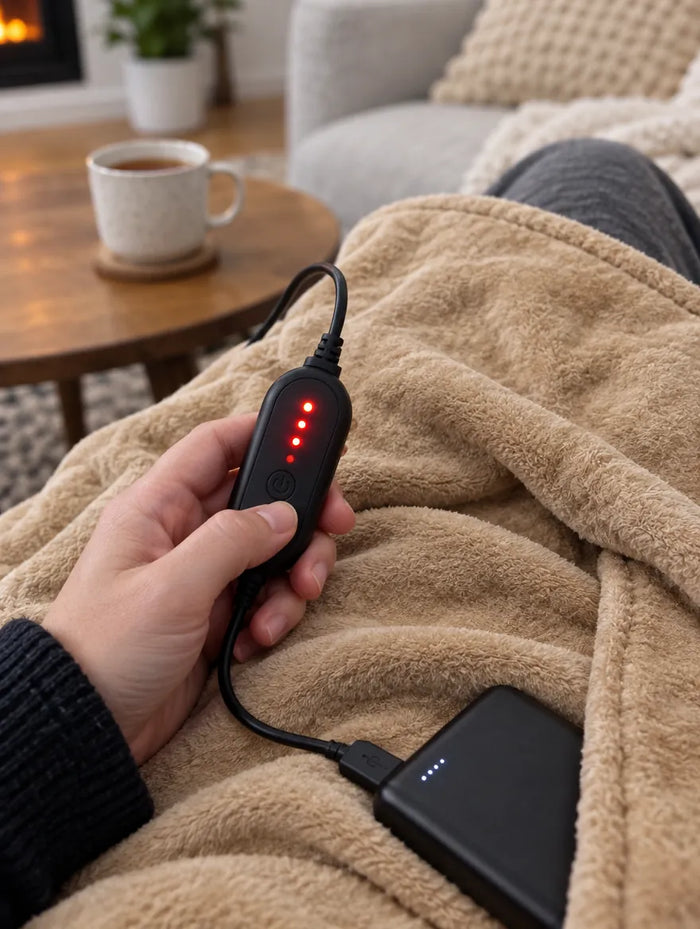
A heating blanket adds to this rather than replacing it: it supplies heat of its own, which matters in a room whose walls and windows stay cold no matter how long you sit there. The trade is a cable, a controller and the manufacturer's instructions — worth reading, and specific to the model rather than generic.
The coldest seat in the house is a known quantity
Ask anyone which chair in their living room is the cold one and they can tell you immediately. It is almost always in one of four places:
- Directly in front of a window — radiant loss, and often a draught down the glass as well
- Beside an external door — including an internal door to an unheated hall or porch
- On a ground floor with floorboards — air coming up between the boards, which is why your feet go first
- At the far end of a long room from the only radiator
Where you sit changes what you need more than any product specification does — and it is the first thing we ask about, because the answer frequently changes the recommendation.
What we look at when we choose stock
Given everything above, the questions we ask are mostly about behaviour rather than numbers.
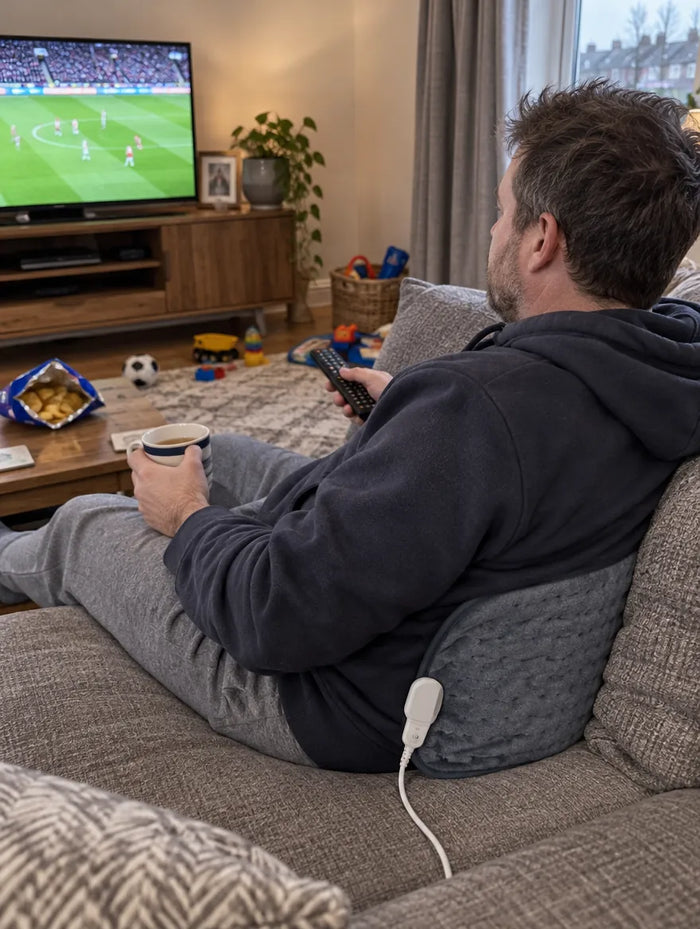
Does it stay where you put it? The most common failure of a blanket on a sofa is not warmth — it is slipping onto the floor every time you move. A fabric that grips slightly does more for how warm you feel than one that is marginally thicker.
Does the edge survive being pulled? Textiles almost never fail in the middle. They fail at the hem, where it is gripped, dragged and tucked a few thousand times.
Does it come out of a wash the same? The first wash rarely tells you anything. The third and fourth do.
Can you put it down? A blanket that has to be folded a particular way to look right is a blanket that ends up in a cupboard.
Three things you will not read here
A figure for your energy bill. We are not going to tell you what warming a person instead of a room does to what you pay. It depends on your house, your tariff, your meter, how you would otherwise have heated that room and how long you sit in it. Anyone who quotes you a saving has made it up, and a number from us would be a guess in a confident font.
A health claim. Nothing on this site says that warmth improves circulation, relieves pain, aids recovery or helps you sleep. A heating blanket makes you warmer. That is a real benefit and it is the only one we claim. For anything medical — or if you are buying for someone with reduced sensation who might not notice overheating — ask a healthcare professional, not a shop.
A price that went up in order to come down. Our prices do not rise in October so that November can be called a sale. The price is the price in June and in December.
Ask us before you buy, not after
If you tell us where you will be sitting — which chair, which room, whether there is a window or a door beside it, whether your feet are up or on the floor — we can give you a far more useful answer than any product page can.
You will hear back from a person within 2 working days, and an honest "we don't know" when that is the true answer. We would much rather talk you out of the wrong purchase than process the return.
What you can count on
30 days to change your mind. The law gives 14; the rest we add ourselves, on the same terms, with no reason required and none asked for.
No fixed percentage deducted from a refund — not for missing packaging, not for anything else. If a deduction ever applies, we show you how it was calculated.
Six months in which the burden is ours. If a fault appears within six months of delivery, we have to show the goods were sound, not the other way round. You can bring a claim for up to six years.
Free UK delivery on everything, no minimum spend, and the total at checkout is the total.
A reply within 2 working days, from someone who has had the product in their hands.
Harwelton
- Address: St Ann's Road, Harrow, Middlesex HA1 1HS, United Kingdom
- Email: support@harwelton.com
- Customer service hours: Mon–Fri: 09:00–17:00
- Sat & Sun: Closed
- Response time: Within 2 working days
Check stock in store

Availability can change at any time. To be sure, please contact the store before you buy.
 Free Delivery
 30-Day Returns
Put your feet up, the properly comfortable way
Lying back with your legs raised is one of life's simple pleasures, and this wedge makes it far more comfortable than a stack of cushions. The high-density memory foam is firm enough to hold its shape while you're using it, and it is roomy enough for both legs, at 61 x 53 x 20 cm. Use it at night or for a short break during a busy day, on the bed or the sofa. The plush cover is soft and breathable, comes off for washing and won't show marks as quickly as white would.
Why you'll love it
- Roomy design: Measures 61 x 53 x 20 cm, with space for both legs.
- High-density memory foam: Firm enough to keep its shape while in use.
- Plush cover: Soft, breathable and a practical choice for everyday use.
- Removable and washable: Slip the cover off when it's time for a freshen-up.
- Bed or sofa: Works for an afternoon break as well as at night.
Perfect for: resting after a long day, reading in bed, sofa evenings, lying on your back
We offer fast, free delivery with no minimum order value. Every order can be tracked at any time using its own tracking number.
We offer a 30-day right to return or exchange if for any reason you are not satisfied with your order.